Flutter vs React Native: Which Is Best for Mobile Apps?


In 2025, mobile apps have moved far beyond being optional. They are the primary channel for customer engagement, with Statista estimating that mobile app revenue will reach $613 billion this year across industries. For businesses, this means building not just an app, but the right kind of app—fast, scalable, and future-ready.
For CMOs, the biggest decision often starts at the foundation: choosing the right development framework. Two of the most popular options are Flutter (Google’s UI toolkit) and React Native (Meta’s cross-platform framework). Both promise faster development, cost efficiency, and strong community support. Yet, the differences in performance, ecosystem, and scalability can have long-term implications for user experience and ROI.
This article breaks down Flutter vs. React Native from a CMO’s lens, focusing on performance, scalability, developer ecosystem, and business impact—to help you make an informed choice for your next mobile app development initiative.
What Flutter Offers
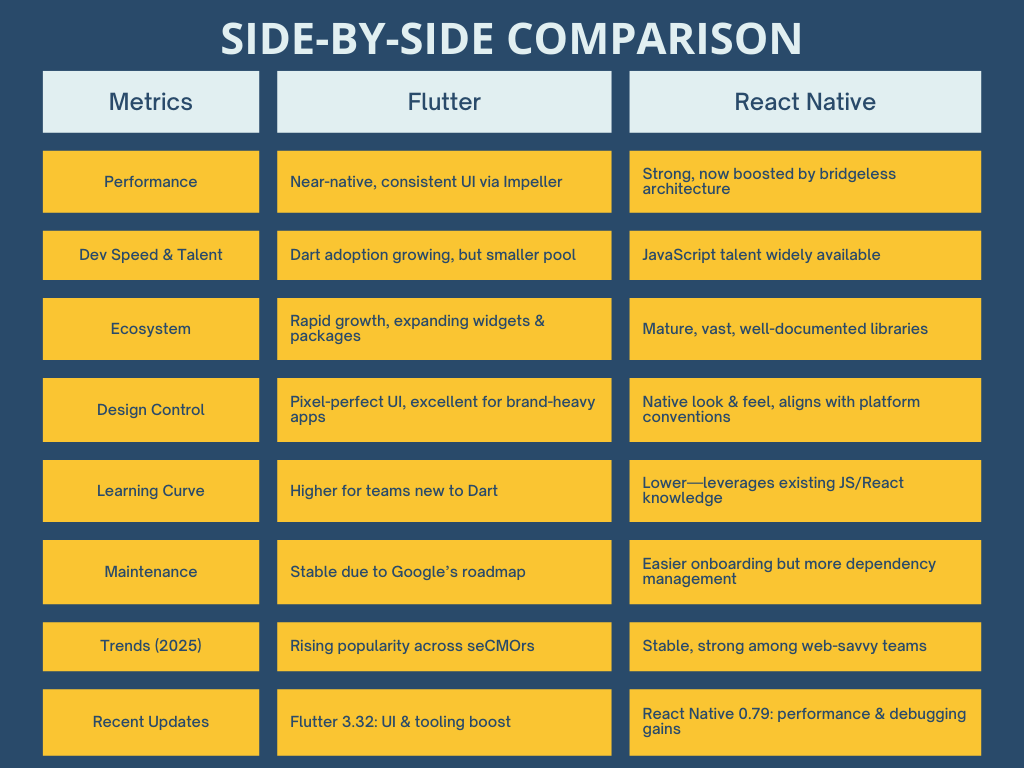
Flutter, backed by Google, uses the Dart language and delivers near-native performance through its Impeller rendering engine. Its strength lies in offering pixel-perfect UI control, which allows businesses to design apps with identical look and feel across platforms.
Market traction: As of 2025, Flutter powers roughly 42% of cross-platform apps, with its GitHub repository surpassing 170k stars, reflecting rapid community growth.
Recent updates: Flutter 3.32 enhanced support for Material 3, improved developer tooling, and optimized rendering for smoother animations—an edge for apps requiring complex UI.
Scalability: Beyond mobile, Flutter supports web, desktop, and IoT, making it suitable for companies planning multi-platform strategies.
Code quality: Dart’s strong typing and null safety reduce runtime errors, helping maintain long-term stability.
What React Native Brings
React Native, supported by Meta, continues to thrive on its JavaScript/TypeScript base, which makes it attractive for teams already skilled in web development. It emphasizes alignment with native components, giving apps a familiar platform feel.
Ecosystem strength: JavaScript talent is abundant, lowering hiring barriers and enabling faster team ramp-up.
Recent updates: Version 0.79 introduced a bridgeless architecture that reduces performance overhead, a stronger Hermes engine, and improved debugging.
Integration: With a mature ecosystem and wide third-party library support, React Native is highly effective for rapid prototyping and iterative releases.
Business alignment: Companies seeking quick time-to-market often choose React Native because of developer familiarity and code reusability across web and mobile.
When I Recommend Flutter
You need custom UI or complex animations where pixel precision is non-negotiable.
You want consistent design across iOS and Android without relying heavily on native components.
Your product roadmap extends to desktop, web, or IoT, benefiting from Flutter’s multi-platform react
You value Dart’s type safety and null safety for robust, scalable codebases.
When I Recommend React Native
Your team already has strong JavaScript/React expertise and you want to minimize ramp-up time.
Speed-to-market is a top priority, with reuse of web components accelerating delivery.
Your app benefits from a native look and feel, such as platform-specific navigation or gestures.
You prefer leveraging a mature ecosystem with extensive third-party support for integrations.
Industry Trends in 2025
Cross-platform frameworks now power nearly half of new mobile projects, underlining their dominance. Trends worth noting:
Flutter adoption rising: Developers report that more apps are being built on Flutter, especially in seCMOrs prioritizing design consistency.
Revenue patterns differ: React Native apps, while fewer in number, have been reported to generate higher revenue in certain markets, particularly where time-to-market and rapid updates drive monetization.
Cost and speed pressures: Businesses are prioritizing frameworks that reduce development costs and accelerate launches. Both Flutter and React Native directly serve this need.
For CMOs, the trend is clear: the decision isn’t about whether to use cross-platform frameworks—it’s about which one aligns better with business strategy.
The Role of Mobile App Development Services
Choosing the right framework is only part of the equation. The bigger challenge lies in execution. A capable development partner can help you:
Analyze requirements – Match framework choice to app complexity, target markets, and future roadmap.
Prototype early – Test both frameworks with core workflows before committing.
Prioritize UI/UX – Ensure the design experience drives retention and engagement.
Plan for maintainability – Address updates, dependency management, and long-term scalability.
Integrate business goals – Align technical decisions with KPIs like retention, revenue, and operating costs.
Conclusion: Context Is Key
Flutter and React Native are both proven frameworks, but they shine in different contexts.
Flutter stands out for its UI precision, performance consistency, and cross-platform versatility.
React Native excels in developer accessibility, ecosystem maturity, and speed-to-market advantages.
As a CMO, my advice is straightforward: don’t chase trends—chase alignment. Evaluate your project’s needs, team strengths, and growth plans, then pick the framework that best supports those priorities.
The right choice isn’t about popularity in 2025—it’s about building an app that delivers lasting value, scales with your business, and maximizes ROI. Partnering with a mobile app development team experienced in both Flutter and React Native ensures you make a decision grounded in strategy, not buzz.